Active Learning in DeepRod for Granular Behavioral Phenotypes

Our paper,“Active Learning in DeepRod Enables Efficient Discovery of Granular Behavioral Phenotypes,”has been published in *Current Research in Behavioral Sciences *.
What is the biggest struggle in applied ML research today? Validating methods in a way that shows real-life significance, not just good metrics on benchmarks. In healthcare and drug development this is critical. We want the chatbot that doesn't just win benchmarks but actually helps patients, and we see that from the real outcomes: better survival rates, earlier diagnoses, fewer compounds failing late in development, real pharmacological effect.
That is exactly what our recently published paper on advanced active learning for automated behavioral analysis is about. We don’t have a chatbot. We have a computer vision system that automates behavioral phenotyping of rodents in pharmacological studies. The problem: Preclinical behavioral studies generate 14 to 24 hours of video footage per animal. Manual annotation is a bottleneck in this process. Our platform, DeepRod, automates this step. But automated models require training data, and annotating behavioral scenes is precisely the kind of expert work we actually want to reduce.
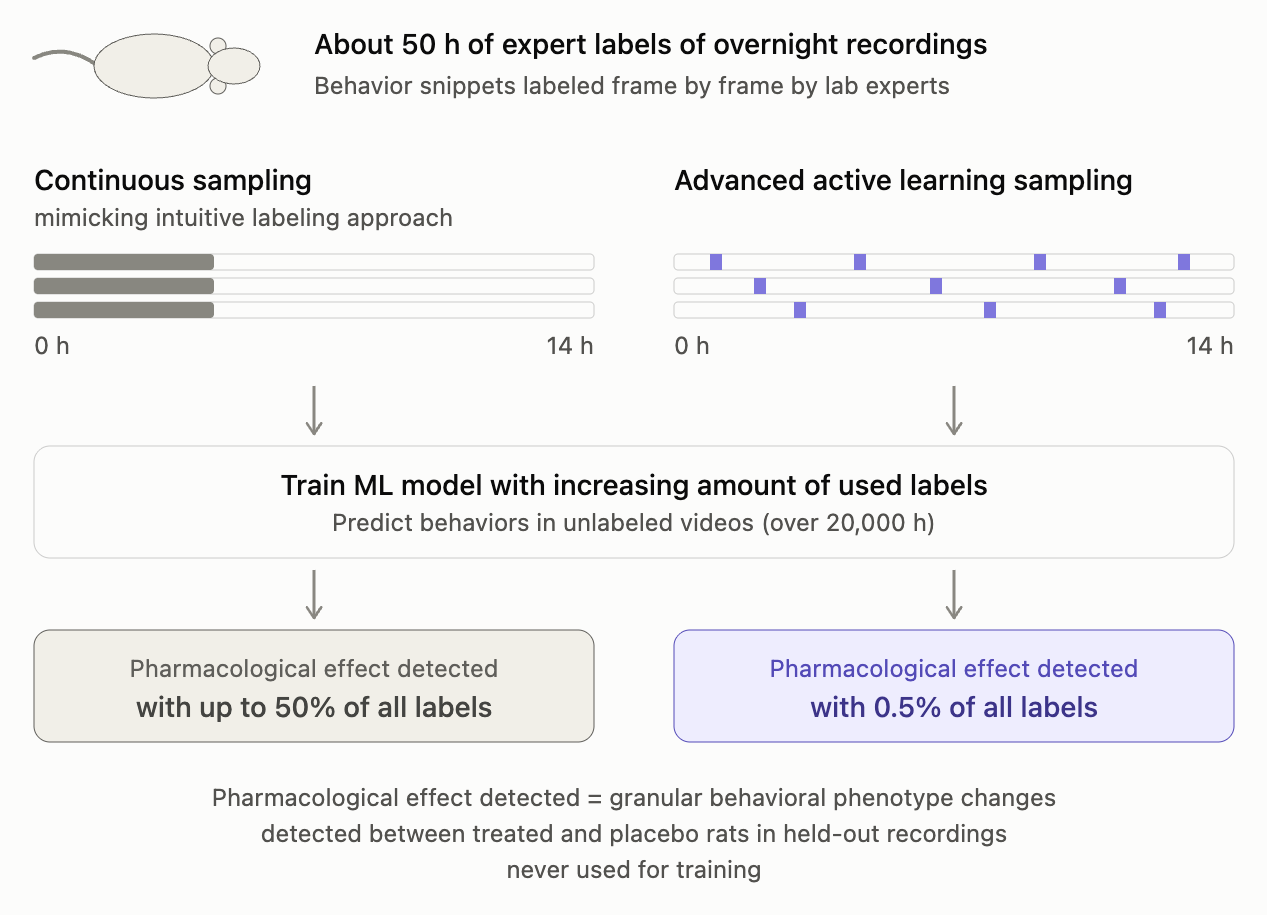
Advanced active learning methods solve the annotation burden by selecting only the most informative samples for labeling. We didn't just show it improves classification accuracy, we showed that the model trained on just 0.5% of a full labeling set, still detects statistically significant drug-induced behavioral changes - the same effects the fully-trained reference model detects. Including fine-grained distinctions like Apathy versus Sleep under Clonidine treatment, which coarser methods collapse entirely.
So the conclusion is not simply, “The model is accurate,” but rather: The model is accurate, and the pharmacological conclusions remain valid.
None of this happens without the collaboration. Boehringer Ingelheim's scientists didn't just provide data, they defined what a meaningful result looks like in a preclinical setting. That domain knowledge shaped the method. The active learning component specifically hunts for boundary samples between semantically adjacent behaviors because pharmacologists told us those distinctions are what the science actually turns on.
This is what we build at Merantix Momentum: ML that's validated against outcomes, not just benchmarks, built with the people who understand the domain well enough to define what outcomes matter.
Subscribe to the Merantix Momentum Newsletter now.
More articles





Active Learning in DeepRod for Granular Behavioral Phenotypes
Our paper,“Active Learning in DeepRod Enables Efficient Discovery of Granular Behavioral Phenotypes,”has been published in *Current Research in Behavioral Sciences *.
What is the biggest struggle in applied ML research today? Validating methods in a way that shows real-life significance, not just good metrics on benchmarks. In healthcare and drug development this is critical. We want the chatbot that doesn't just win benchmarks but actually helps patients, and we see that from the real outcomes: better survival rates, earlier diagnoses, fewer compounds failing late in development, real pharmacological effect.
That is exactly what our recently published paper on advanced active learning for automated behavioral analysis is about. We don’t have a chatbot. We have a computer vision system that automates behavioral phenotyping of rodents in pharmacological studies. The problem: Preclinical behavioral studies generate 14 to 24 hours of video footage per animal. Manual annotation is a bottleneck in this process. Our platform, DeepRod, automates this step. But automated models require training data, and annotating behavioral scenes is precisely the kind of expert work we actually want to reduce.
Advanced active learning methods solve the annotation burden by selecting only the most informative samples for labeling. We didn't just show it improves classification accuracy, we showed that the model trained on just 0.5% of a full labeling set, still detects statistically significant drug-induced behavioral changes - the same effects the fully-trained reference model detects. Including fine-grained distinctions like Apathy versus Sleep under Clonidine treatment, which coarser methods collapse entirely.
So the conclusion is not simply, “The model is accurate,” but rather: The model is accurate, and the pharmacological conclusions remain valid.
None of this happens without the collaboration. Boehringer Ingelheim's scientists didn't just provide data, they defined what a meaningful result looks like in a preclinical setting. That domain knowledge shaped the method. The active learning component specifically hunts for boundary samples between semantically adjacent behaviors because pharmacologists told us those distinctions are what the science actually turns on.
This is what we build at Merantix Momentum: ML that's validated against outcomes, not just benchmarks, built with the people who understand the domain well enough to define what outcomes matter.


